One Prose Poem by Kyla-Yến Huỳnh Giffin

Take Care/Warmly

As the worst snowstorm in a decade encroaches, I pour canned chicken noodle soup into a pot on the stove and weep. I am sick, and I want my mother’s globby, bland mess of cháo. I want my father to yell at me that I am not sick, then yell at me for vomiting in the sink. I want to vomit a dozen times then faint in the shower, and wake up just to vomit again. I want to be suffocated by Vaporub and humidifier steam. I want to be reminded to not burden others and not be dramatic and not forget what I owe and do not deserve and not remember what was done to me and not need any caring for. I want to be taken care of in the worst of ways. I want to be reminded that I can be taken care of in the best of ways. I want to make a promise to you. That when the blizzard hits, I will let you in and turn on the heat and forget the gas bill. I will knit you a scarf and offer you hot tea and hot soup and hot poetry. I will hold your cold hands. I will let you warm them on me. I will not shut you out with the cold. I will never be so sick as to stop being a lover and a friend and a furnace and an artist and a mother. I will care for you. I will care sweetly. I will care tenderly. I will care madly. What other way is there?


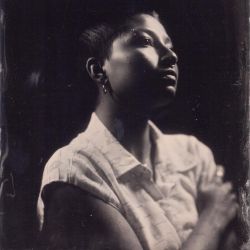
Kyla-Yến Huỳnh Giffin (they/them) is a queer and trans, biracial, Vietnamese unamerican diaspora writer based in Boston, MA. Their work revolves around the intersection of dreaming/fantasizing/futurizing and grieving, and focuses on topics of care, diaspora, transness, ecology, empire, and intergenerational histories. The Founder and Editor-in-Chief of Xenolithic Edges Literary, Kyla-Yến’s work has been nominated for the Pushcart Prize, Best of the Net, and Best Small Fictions, and appears or is forthcoming in The Offing, ANMLY, fifth wheel press, DISCOUNT GUILLOTINE, and other publications. They are a 2026 BIPOC Fellow for Trans Poetics Archive, a Press Editor for Half Mystic Press, and a Co-Coordinator for Sundress Publications’ Poets in Pajamas reading series, and have taught writing workshops independently as well as for Split This Rock, Mendocino Art Center, Sundress Academy for the Arts (SAFTA), and more. Their work has been supported by Tin House, Martha’s Vineyard Institute of Creative Writing, Seventh Wave, Abode Press, and more. You can visit Kyla-Yến’s author page at www.kylayenhuynhgiffin.com, and find them on Instagram @yenshrine.

One Prose Poem by Lavanya Arora

Fly Dog

i run my fingers through its thousands of ommatidia to learn / what knowledge evolution imparts on wild things / with domestic names. i wash its hairy legs / with my long and strong shampoo. it must’ve been fighting / fleas for a taste of dung caked on a cow’s bony ass. i wash its / plungermouth with hydrochloric acid before letting it anywhere near / my face. it can survive / this. it can survive anything i throw at it and i’ve thrown it all: my hardbacks, electric bats hungry for arthropod blood, my hands, my freelance salary at imported A5 wagyu dungcakes. it wants none of it. always headbutts me a gift of ocelli, which tells me it’s time / for a fly. we drive and it buzzbarks / at the monochromatic kaleidoscope of other fly dogs in the park. they rave over other companions’ rancid heads. they bin hop. garbage crawl. zip in circles chasing their own ghost tails. by the time mosquitoes have mafia’d their way into the park, they’ve all spiralled down. are sprawled on a carpet / of their own wings. they stretch / their hairy foreleg towards each other like protagonists / in their final act. the ampulla in their head-heart dreaming / of every leg, of every stump they’ve ever humped. every cow they’ve chased down every garbage-lined street. every asshole they’ve ever sniffed. and loved. and hated. and loved again.


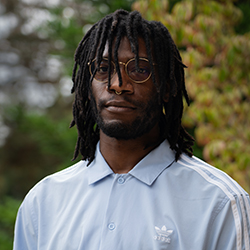
Lavanya Arora (they/he) is an independent biology & food researcher and writer from India. Their literary work has found a home in journals like The Manchester Review, Frontier Poetry, Josephine Quarterly, Honey Literary, and ANMLY, among others. They dream of extensive dinner dates with fictional characters while (begrudgingly) editing their debut novel and poetry manuscript. They’ve been longlisted for the 2026 Commonwealth Short Story Prize. Find them on Instagram @lavaurora.

One Poem by Stevie Subrizi

Ravens Aren’t Songbirds, and We’ll Never Meet Again

Any message well composed will ring a bell of truth; for example, 
three ravens sang to us that day at the waterfall. Bad example. 

A chain of emails proves that you don’t love me, and that I drove myself 
insane over you—I mean, straight into you. I’m sorry. My insurance 

won’t cover this. Only time will cover it. Time deletes all messages. But 
those ravens still perch by that waterfall. Once, a young man 

invited you to bed, and that bed cruised down a waterfall, and candles
formed a ring around it and made of its occupants a burnt offering. 

These archives have been deleted by now. This man is not a man anymore, 
but something prettier. Something more like you. And now, 

a new man has arrived for you, with a new bed and fresh candles, and 
you must have adopted a dog and bought a nice writing desk together, so 

I’m sorry for driving into you again. My insanity is a sputtering time machine 
that crashes straight into all my favorite landmarks. We were never 

supposed to cross paths at all. Erase this message. Bury me in Potter’s Field. 
Keep your dog and man and writing desk. I have ravens to feed.


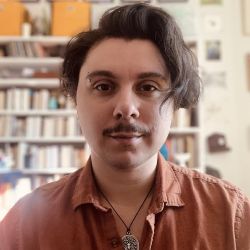
Stevie Subrizi (they/she) is a genderqueer poet and rock singer-songwriter in Massachusetts. They are a former cohost of the Boston Poetry Slam at the Cantab Lounge. Their chapbook Alone and Naked Inside of a Whale is the winner of the Yemassee Journal 2021 Poetry Chapbook Contest, judged by Dustin Pearson, who described its poems as “convey[ing] gravity and reality with incredible generosity and humor.” You can hear their songs at steviesubrizi.bandcamp.com.

One Poem by Sora Anindya

Local Crip Yearns for Kuyang Sighting

I.
She floated through the humid night.
Jet black long hair gleamed
under the moonlight.
Free spirited, wild hearted,
she waltzed in the dark.
Fuck. She got stuck.

II.
Mimi told me about the night
Kai rescued a kuyang.
First a faint cry.
Second human organs,
tangled on the clothesline.
Tolongi ulun. Ulun handak bulik…
The blood dripped. You would have thought
Kai was terrified. He carried her back to her house.

III.
Two decades ago we moved to Jawa.
I wondered if kuyang
could cross the seas.
Kadada kuyang di Jawa, said Mimi.
Whenever I looked into the night sky,
I prayed it would be the night I saw her.

IV.
Can’t see the night sky from my bed.
I doubt she would ever
knock on my window.
2 AM routines: limbs stiffened,
joints throbbed, spine pulsed.

V.
Just how badly I want to be her: no limbs, no joints, no spine.
No pain.
A hungry beauty.
Seeking all things bloody.


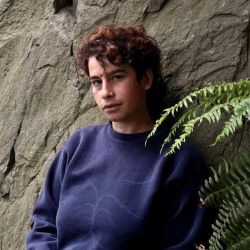
Sora Anindya (they/them) is a Banjarese-Javanese Mad, Autistic, crip, and queer writer/poet/translator/extraordinary machine from Indonesia. Everything they write is written from bed, either in pain or in between pains. They mainly take inspiration from the aching of their jiwaraga (soulbody), the rekindling of connection to their birthland, and the everblooming queerness. Their poems are published or forthcoming in Suara Kita, Corporeal Lit Mag, Apricus Literary, and re:wave press.

One Story by KB Brookins

Bitch Shopping

We come from Stop Six. Eastwood. Woodhaven. From Eastchase. From Poly. We say the names of our hoods with a twang only found in Fort Worth, Texas that sounds like a lullaby. Thick with pride, vowels elongating till our vaselined lips touch. Even if you hear the names and nothing comes to mind, no street corner or tree, you know based on the way we say them that the entire length of our short lives are wrapped inside these places. You hear us lilt Stop Six and say I’ve been there—because you have. Or you will now, after hearing these streets that we’ve tatted on our still-growing bodies. We say the names of our hoods like they are earned scars. They are our whole world. 

We wear plaid boxers and cartoon briefs mopped from our hood’s Walmart—the one with boxes around the tampons and Shea Moisture that need to be unlocked by employees. We sag our pants and won’t wear bras unless they have Nike checkmarks on them; we wear them until they become outstretched like our granny’s hands at prayer and workshop. We pantomime things we’ve only heard drug-dealing boys and drug-smoking uncles and too-there preacher daddies or not-there deadbeat daddies say: A man should lead and bitches be shopping. We are girls that love to hug and kiss other girls, who lock lips with pretty femmes in empty hallways and on dates at the Parks Mall (or Northeast—depending on how far out our mama’s wanna drive). We are the girls that moms warn against, the girls-turned-ghosts in an instant.

This day, we mobbed at Parks Mall. 

We walked into Parks with nothing but twelve dollars and the clothes on our backs—CJ in creased denim, Jamie in a distressed shirt and jeans, Kameron in a hodgepodge of dollar tree apparel. Everything in the stores was too expensive for our skimpy budget, so we posted up at the food court. We commented on every girl that walked past like she was an object—of our shallow affection or meaningless disdain, TBD.

“Goddamn!” CJ said. Her real name was Chaundra Hallelujah Jones. A girl in baby phat jeans walked by. “Shawty got an ass on her.” 

“Imma spend a couple grand on her,” Jamie said a la Gucci Mane, then laughed. 

“Imma pop a rubber band on her,” CJ said. 

Jamie started beat-boxing, then we started freestyling. 

“Man, I could pull her if I really wanted to,” CJ said. 

“You say that about errbody,” Jamie quipped. 

“Cause it’s true.”

“Shid, what happened with ol girl from Everman then?” 

CJ’s nostrils flared. Her public breakup with a straight girl that worked at La Gran Plaza was not to be discussed. 

“Chill bro,” Kameron said to Jamie.

Parks Mall was a tile and fluorescent light-filled utopia for us. It was always teeming with teen girls of any race and shade. We gazed at them while they stood in lines at Panda Express, Dickey’s, Popeyes. We did not look at Claire’s; any girl going in there was basic, according to CJ. We agreed on most everything CJ said. We determined if the girls were gay (and therefore not CJ’s type) from their bracelets (are they wearing “I<3BOOBIES” ones?), outfits (spaghetti straps = straight), hair (shaved head = gay), and the nature of their looks at us. A sneer = straight. Attraction = gay. Fascination = at least bicurious. CJ thought she could “turn” the bicurious girls. Most girls sneered (especially at Kameron) or didn’t look our way at all. We were often three of ten butches max out of an ocean of girls who filled every crevice of the mall.

“I’m bored,” CJ exclaimed dramatically, Dippin’ Dots in hand. Our hang was going according to schedule: act like we were gonna buy something, eat, stare at girls, then eat Dippin’ Dots. What more could CJ want? “Let’s go bitch shopping.” 

“Man, hell naw,” Jamie said. 

“NO,” Kameron followed sternly. “Last time yo ass ran laps around us.” 

“I mean, not really,” Jamie corrected. “I was only two numbers behind.”

“But you lost,” CJ said, then hit Jamie’s shoulder. Jamie and Kameron creased up their faces. “C’mon bros, it’s fun.”

“I don’t know, man. I always come in last or end up being one of y’alls wingmen,” Kameron said, looking long-faced at her cup full of vanilla and chocolate ice bubbles. Though she was always finishing her food first and weighing as much as CJ and Jamie combined—she always said Dippin’ Dots tasted like the back of a freezer. We ate it anyway.

“Bro,” Jamie said to Kameron. “You almost got a number last time.” 

“If you count the fake number she got, then yeah,” CJ said under her breath, chuckling. 

“Let’s see The Grudge 2 instead!” Kameron said. Though she hated scary movies, she would’ve rather done anything but bitch shop. 

“Broski’s,” CJ said, putting her arms over Jamie and Kameron, “I need this. Please.” CJ did just get dissed at the game—the straight girl acted like she didn’t even know CJ when her boyfriend walked up—so I guess we could be game. Jamie and Kameron sighed in sync, then a girl walked by in a pink velvet tracksuit with a perfect coke-bottle frame—the kind that would bring tears to Gucci Mane’s eyes. Her hair was swooped back in a perfect bun, and she had matching pink flip flops that highlighted a fresh french-tipped manicure. Her oak tree skin had never seen a blemish.

“Hey,” she said, walking past us. Not in a snarky way, or off putting way. In the warm way we weren’t accustomed to. She even made eye contact with Kameron. 

We all looked at each other, bathed in her beautiful glow. 

“Close your mouth,” Jamie told Kameron. “It’s rude.” 

*

We planned out the areas where we would bitch shop. CJ liked Forever 21, H&M, and Aéropostale—“more quality women there,” she claimed. Jamie liked Zumiez, Hot Topic, and Spencer’s. “If she looks at the dicks rack at Spencer’s, she’s gay,” she said as if she couldn’t make it any more obvious. Kameron was still uninterested in playing—instead wanting to track down the girl in the pink velvet tracksuit.

“Why?” Jamie asked Kameron. The girl in the velvet tracksuit was the kind of drop-dead gorgeous you only see in rap videos or America’s Next Top Model (to be clear, they only know about this show from ex girlfriends). “Sometimes girls are nice to let us know they not homophobic.” CJ nodded his head. But no girl had ever even looked Kameron in the eyes. Why wouldn’t she at least try? 

“Why not?” 

Jamie sighed. “She was prolly just bein nice.” 

“Though I hate lesbians,” CJ said, putting her hands over both Kameron and Jamie’s shoulders, “she’s likely the finest thing in this mall besides the slices of brisket at Dickeys. What if we said getting her number would be a win that trumps them all, huh? Would you play then?” 

Kameron was all of a sudden convinced. 

“Otherwise, the stud with the most numbers in two hours wins. Leggo!” 

CJ went to her designated stores; those suburban girls swarmed her like funky cologne swarmed everyone at Abercrombie & Fitch. Any girl who was a little bit curious about girls got drunk on her muscular build, her lemon skin, her long, 3C hair she kept frizzy and tied in a low ponytail. They’d ask to touch her arms. She’d brag about being on varsity basketball (she was a bench rider, just built like her daddy). They’d laugh too hard at her jokes about imaginary people she crossed up on the court. She’d promise to call them after her mama went to sleep—the only hour when she could safely cake on the phone. Per usual, CJ blew up the Broski group chat with her bragging.

CJ: just got a number from a girl who looked like Kyla Pratt, swear to god. 
CJ: & after she walked away, I got her friend too *devil emoji*
J Dawg: thas dirty G
CJ: oh shit, I double-backed at Forever 21 & got ol girl’s number!
J Dawg: the one that gave me coupons?! I swear bro *cussing emoji*
CJ: dont hate me cause you ain’t me

Jamie was a goth white girl’s dream. More than lean, she’d flash her six pack (it was actually her rib cage) or shake her pencil-thin locs, and those girls—with their Tripp pants and Black tutus—would swoon. Jamie had white step-siblings that taught her all the words to every Three Doors Down and MCR song. Though they ate up all the food and treated her like she was a dark-skinned butch Cinderella, they at least made her a magnet for alt girl affection. She sang along to the music in those too-dim alt stores and gravitated toward the saddest girl in the room. 

J Dawg: *insert pic* just got this honey to agree to come w/ me to the movies XD
CJ: yo… she kinda look like yo lil sister
J Dawg: wtf?! Bro chill
CJ: I’m not playing! Nigga you tryna date yo sister?! *laughing emoji*
J Dawg: Wait till I find yo ass

Kameron was struggling. If she played this game and came back with no numbers again, she’d never hear the end of it from CJ. Just train with me and the basketball team, CJ would say. Then they’d throw their panties at you. Kameron couldn’t even talk to a girl—let alone train with a whole group of them. She checked Victoria’s Secret & PINK, Sephora, and Express for the beautiful girl in pink. She peeked into the mall hair salon, though no Black girl would ever step foot in there. They all looked at her like she was The Grudge herself, so she left. She even got desperate and checked the dreaded Claire’s. She found nothing but a crying little white baby who’d just gotten his ears pierced. The right earring was a whole two inches above the left one. 

Frustrated and winded by the walk, she took a pit stop at Auntie Anne’s. Cinnamon sugar bites, little hot dogs, and glaze: the exact dessert she preferred over Dippin’ Dots. Might as well eat what I want if imma get shit on for a week, Kameron thought. She ate it indulgently, getting cinnamon sugar all over her cargo pants and Hollister tee. She even got it on her beanie (it was 80 degrees outside, but she was embarrassed by her matted straight-back braids).

And then, the girl in pink sat next to her. 

Kameron didn’t even notice her at first—too engrossed in her crusty, dough-filled meal. She ate and ate and, out of the corner of her eye, saw this beautiful girl. In a reflex, she fell out of her chair; though she was cake-wide, the chair had more than enough room for this to be avoided. She said “Sorry” but not to the girl; instead, her sorry was aimed at the chair. Fuck, she said under her breath, straightening out her straight-back braids. The girl laughed, then reached out her hand to help Kameron up. 

“Hey,” the girl said. The sound of her voice opened Kameron’s sinuses. This girl’s speech danced around her ears in a way that made hey sound like handsome, marry me

“Yes,” Kameron said. 

The girl looked at Kameron with confusion. 

“Sorry. Hey!” Too eager, but close to normal she thought.

“Cameron,” she said, holding out her hand so Kameron could shake it.

“Really? My name is Kameron too.” 

“Oh yeah?” 

“Yeah forreal—I’ll show you.” She pulled out her vertical ID. It had a picture of the Texas capitol that she’d never seen IRL embossed in its background.

“Maybe it was meant to be,” Cameron said, smirking. 

Kameron blushed harder than what should be legally allowed. 

“Where you from?” Cameron asked. 

“Stop Six.” 

In that moment, Cameron became the glaze in the corner of Kameron’s mouth. She was already soft and sweet, but she didn’t know a cadence, a voice could be a song that she wanted to listen to again and again. She didn’t know the name of a place could invoke pain and pleasure at the same time. She wanted this pain, this pleasure—she wanted Kameron’s mouth. Cameron looked at her as if she could listen to her say anything it all day. When Kameron said Stop Six, she heard and felt I’m from where you feel safe.

“I’ve been there,” Cameron lied. 

*

“Where the fuck is Kameron?” CJ said, winded on the ice skating rink.

“Ion know,” Jamie replied. “But we said meet here at 8.” 

“And you know my mama don’t play. I aint bouta get yelled at again.” 

“Exactly. She better bring her ass on,” Jamie said, slipping then catching her balance.

“How many numbers?” CJ said, smirking at Jamie. 

“… three—”

“THREE?!” CJ starts laughing. “Try eight. The better stud wins again.”

Jamie looked at CJ with scorn, or envy, or sadness—some emotion that every masc lesbian has felt but the English language doesn’t have a word for. Rappers don’t have a bar for it either—being on the losing end of a game of desirability, playing a game rigged against you from the beginning if you’re dark, fat, or in any category seen as a problem. Of course, CJ wins. Of course, CJ loves to win a game that Jamie and Kameron lose cause it makes her feel less like a loser. What’s the point of playing if the outcome never changes?

Jamie pushed CJ down then skated away. 

“What the fuck bro?” CJ said. She got up, then sped up to Jamie and pushed her down. Jamie tripped CJ, then they started tussling on the cold ice. 

Black kids pulled out their phones. White kids froze or started crying. Brown kids got off the ice; one started trying to pull them apart. CJ elbowed one girl, then yelled: 

“Get out the way, bitch!” 

“Excuse me?” the girl replied. Only then did CJ notice it was a girl whose number she got earlier. 

“Oh, I’m sorry baby—”

“Bump that,” the girl said, then skated away, leaving her vulnerable.

Jamie jumped on her back, then they fell again. 

Kameron and Cameron saw the commotion from afar, then hurried onto the rink to break up the scene. “What the hell is going on?” 

“Man, where the hell you been?” CJ said.

“Well,” she said, then gestured to Cameron, who was dabbing Jamie’s broken lip. CJ looked at her with disbelief.

“All of you: OUT,” yelled a man struggling to skate to them. He had on a security uniform and blew on a whistle. 

“What? We aint even do nothin,” Kameron said. 

“Don’t care. OUT,” he yelled, before falling down. We got off the rink and were escorted outside.

All of our mama’s (plus Cameron’s) were called. Jamie’s mama had to be talked out of whooping her ass in front of everyone by the security guard. CJ’s mama kept repeating that she didn’t want her hanging out with us anyway. Cameron’s mama just looked at her with disappointment, then said, “Let’s go home.” Kameron’s mama didn’t answer; she was at work and couldn’t be on the phone. 

Kameron waved goodbye to Cameron and for a second, she was proud of her life. Though she knew she was gon get a fresh ass whoopin once her mama got off of work, and the likelihood of her seeing Cameron again was slim (on the way out, her mother forbade her from ever talking to us again), still, she was proud she made a person of the same gender feel something besides dread. Kameron got a ride home from Jamie’s mama and sat in the backseat, thumbing through the Scared Straight packet she was given by the security guard with a smirk on her face. Maybe it wasn’t all curtains for Kameron; she could even get a girlfriend one day. She texted the Broski chat:

Kam The Man: I won. 

Nobody replied.


KB Brookins is the author of three books, including Pretty (2024), winner of the Lambda Literary Award in Transgender Nonfiction. They are an Assistant Professor of Creative Writing at Santa Clara University. Follow KB online at @earthtokb.

Two Poems by Christian M. Ivey

black non-monogamy lover

every where i go                               its too much to be one thing                       to be a fixed idea yet in motion
                                                like gossip from a mouth                              a whisper from the grapevine for
              the ears of those who want it most                           closer to death by age and drugs                     i’m
always surprised when i awake & the walls aren’t made of the same fire
              that burns in the look of my lovers’ eyes when i first arrive
                                                                                                                               to their doors.                                                  
                                                                                                                               surely God had a hand in answering
                                                                                                               the long wish
              i hid under my tongue                                                    ignoring the saltiness as if it were the sweat
dripping from cruising in Sodom.                                           working at Looking Glass in Chocolate City,
jacked in Atlanta                                                                             or a grinder in the Bay
                              the sins of Gomorrah carve my being down to flesh
                  no matter who i lie down with                              there is no human to devour
                              only ribs–thighs–legs–breast–wings–head–heart–hole.

Cis-sexism Tennis on a Sunday Morning at Athol

You’re a man                     why are you hitting
the ball so hard at her

the black lady with her friend 
asked when I got back to the baseline

I’m not sure if it was the grace in the toss
the yellow of the ball spinning under the endless

 blue of the sky or the inward rotation
of the forearm to move from on edge to action.

But I did it the way Venus does on YouTube,
how Serena did it in the highlights,

yet                         still a man                           maybe it’s my beard
The bulge in my shorts that flops when I run.

Maybe it’s the lower range of my voice
when I yell come on after a winner,

the flatness of my chest
when I crash out after an unforced error,

or simply             I’m less like her                 a woman
more like her friend.

Finally                  I looked over to the other court
confused pretending it’s the sun in my eyes

for the reason                    my face is scrunched up
instead of her not minding her fucking business.


Christian M. Ivey (he/they) is a black non-binary writer, editor, and art director from the eastside of Pontiac, Michigan, who works to interrogate the mundane to illuminate how blackness is overdetermined by social death through a triangulation of Lacanian psychoanalysis, queer theory, and Afro-pessimism. They are the Digital Communications Specialist for the Othering and Belonging Institute at UC Berkeley and Co-Fiction & Art Editor for Anathema Magazine: Spec from the Margins. He has also guest-edited issue No. 28 of FIYAH Literary Magazine, themed on Belonging; HEXAGON SF MYRIAD Zine on kinship; and The Pleasure Issue of beestung. Christian’s work has been supported by Hurtson/Wright Foundation for Black Writers, Voodoonauts, The Watering Hole, Obsidian Foundation, Tin House, Sundress Academy for the Arts, PREE Studio, Under the Volcano, and more. You can read their work in or forthcoming: Baffling Magazine, beestung, Black Youth Project, and Cosmic Horror Monthly. They are on all socials @ageedubb.

One Poem by Birch Wiley

The Commuter

Does it get you hard,
smoking in the sun?
Walking around in your
white t-shirt and blue jeans,
big black boots and gym socks?
Does it get you off,
looking like the Marlboro Man
of midtown? Don’t you want
so heavy they can smell it
coming off you? Roll
that lighter up in your sleeve,
keep walking, keep leaning
on the world as if
it can carry you, carry you
as far as your next fix
of that special pain
they save for lovers.


Birch Wiley is a transsexual poet living in New York. Their work can be found in Pleiades, Voicemail Poems, and Querencia Quarterly, among others. Their debut collection, Mythweaver, was published by new words {press}. You can learn more about them at birchwiley.com.

Two Prose Poems by Esmé Kaplan-Kinsey

Posthuman Has Zoom Sex

In the twilight of their bedroom, Posthuman turns on the camera. Their body is already a cybernetic system–what remains but the upload? The viral response? Naked, Posthuman adjusts the lighting, assumes a provocative pose, filters personhood into pornography. A predictable shift between states. A (bio)logical response to modernity. Do not judge Posthuman, when they breathe, when they slip a hand between their legs. Only watch. Only be a being with eyes. Only see collarbone, thigh, the shudder of a stomach. The recipient is unimportant–you, not-you, whoever. What matters is the tremble, the softness, the sound–rather, the audio, the clarity of image. The connectivity, and what it carries. The desire to be animal distilled into pixels. Posthuman gasps, feels things unspeakable. The sentient screen simplifies, decodes, projects ghostly ecstasy through space. And that dead red eye of the camera, watching everything. Waiting on climax, or collapse. Where does the camera go when the computer is closed? Nowhere, of course. The sexiest part is the waiting. The desire to witness what happens in the dark.


Posthuman Dabbles in Doublespeak

In the depths of a coffee-fueled internet goose chase, Posthuman reads that 2016’s Word of the Year was post-truth. The prefix makes them feel validated in their own baptismal afterness. It’s always been an insecurity, to be defined by what came before, an embarrassment Posthuman hides under swagger and electric charm and vast projected quantities of not giving a single fuck. Posthuman wanders into the kitchen and eats a banana, sliding a finger along its spotted peel. The fruit is adorned with a round red badge declaring Mexican origin, a white arc of text reading AS FRESH AS IT GETS. If the sticker can rewrite the senses, unmake the rot already inside, what can’t words do? Posthuman chews slowly and considers rebranding. They compose a coming-out. I’M GOING BY POST, they post, and let the comments come stampeding in. They are thinking about bananas, who have no concept of truth, or words, for that matter, and how perhaps the two are the same thing. As in, I say my name and who I am and then it is so. I call myself a scholar or a slut or a human and then it is so. The banana calls itself nothing and simply is. It grows in some jungle, no, more likely some Central American plantation where of course the word plantation itself is banned, because to call it by that heaviness would be to invoke a nastier reality–better to submerge that faraway monocrop in friendly terminology which encourages capitalist collaboration rather than making consumers feel like participants in violation of human rights. Posthuman peels the banana slowly, swallows it in mealy segments, calls it sustenance and makes it so, collects energy from its sugars so they can move their limbs so they can rot on the couch and scroll through their phone. I’m so proud, Post, say the commenters, declarations of support studded with emojis and awe. You’re finally becoming the thing you already are.


Esmé Kaplan-Kinsey is a California transplant living in Munich, Germany, where they are a Visiting Scholar at the Rachel Carson Center for Environment and Society. A 2026 Anthony Veasna So Scholar through the Adroit Journal and a Monarch Queer Literary Award winner, their work appears in publications such as Split Lip, SmokeLong Quarterly, and the Cincinnati Review. Their writing explores human-nature relation and deconstructs binaries casting humankind in opposition to the natural world.