Excarnation by Wren Douglas

Flann’s hand was cool as they pulled Isolde through the Hymenium’s vaulted corridors. Their footsteps echoed in the quiet, and the night chill slithered up Isolde’s gown like a tangle of water snakes.

“I don’t like this,” she said, dragging her heels.

Her fellow novice tugged her forward with a quick smile. “We’re almost there. I promise.”

They moved with urgency, despite the almost invisible flinch here and there; that morning, Isolde had stood still and terrified as the Matron lashed Flann’s back with a leather whip. Five times, for you needed five letters to spell out ‘whore’.

“Short hair suits you,” she whispered into the shifting shadows.

Flann stopped walking. It was so sudden that Isolde bumped into their shoulder, wrenching a muffled whine out of them.

“Oh, Plentiful.” Isolde’s blood ran cold. “Oh, Flann. I’m so sorry—”

“Don’t.” Flann’s voice came out, streaked with pain. “Just don’t. We’re here.”

A river of apologies welled up in Isolde’s chest, but she forced it all down. Instead, she followed their gaze: before them stood a simple arch, not dissimilar from its siblings lining the cloister. It was of simple styling, unadorned, except for a ruined bas-relief on the left capital.

“Did someone take a hammer to that?” Isolde asked, craning her neck.

Flann shook their head. “It’s the material that’s different. Try touching it.”

With only the moon casting light across the corridor, it all looked like sandstone to Isolde. Yet as she placed her palm to the arch, her fingertips dragged against something pockmarked and powdery. Her hand was coated in a film of dust.

“Huh,” she said, wiping the dust on her gown. Before she could check her nails for dirt, Flann grabbed her wrist.

“Don’t be mad now,” they said, and leapt through the arch.

The starry sky vanished overhead as Isolde tumbled after them, replaced by a high stone ceiling riddled with more pockmarks. A tremulous glow with no apparent source bathed the room in blue.

“Flann,” she said, and they beamed at her. As if they’d just executed a fun little trick.

“Isn’t it wondrous?”

The blue glow shimmered as if alive; it glinted off a floor of ceramic tiles arranged in the shape of a giant harpy ripping meat off a carcass. The harpy’s expression was distorted by furor, her talons gleaming with the red of gore, but the mosaic had been arranged so delicately it left Isolde breathless.

“Where are we?” she said, discarding her slippers. Lugging shoes on the tiles felt wrong.

Flann was already treading along one of the carcass’ ribs. “I believe this used to be the innermost chamber of a previous temple, long abandoned. There’s a record of it in the library, though it mainly whines about how long it took to tear it down.”

The damp air clung to Isolde like a cloak. It smelled musty, with a tinge of something like the aftertaste of alcohol in wine biscuits.

“Why tear it down? Surely it would’ve been more practical to make use of it.”

“Well.” Flann abandoned their game of following the rib and wandered close to the wall. “The stone here oozes a sort of foulness. Inhale too much of it, and it will corrupt you.”

A faraway longing nestled in their eyes as they spoke. Isolde grabbed the hem of their camise, dragging them back, and didn’t let go even as they turned their gaze to her.

“Don’t worry,” they said, softer. “We’d have to stay here for days to feel the effects.”

“You took me to a cursed place,” Isolde shot back. “A forsaken place. Of course I worry. The Matron will be furious.”

Flann clicked their tongue. “The Matron serves a god that holds no power here. A god that wants us to give ourselves to violent men, bear babe after babe, and die of miscarriage as they groom our daughters to follow the same fate.”

 Rage spoiled their lovely face as they spoke. Their uneven hair, chopped off the night before with sewing scissors, rustled in a spectral breeze.

It made Isolde’s knees buckle.

“We’re turning twenty-one this year,” Flann said. They were so close she could smell the salve she’d applied to their wounds. “We’ll have to leave the Hymenium, look for a husband. Be wives.”

The choked, painful dip of their voice pulled at Isolde; she cupped their cheeks, rubbing at the moles that dotted their skin. They sighed into the touch.

“I want to have sex that serves no greater purpose.”

Blood rushed its way up Isolde’s neck. The scent of the salve clung to her, and her hands tingled with the memory of bare skin underneath. She swallowed, looking down at the slim space between her and Flann’s body.

A satchel hung off their belt, unassuming and unfamiliar. Isolde traced the knot that kept it closed, listening to the dips in Flann’s breath. Then she pulled it loose.

Inside was a harness of woven cloth with a ring in the middle, and a long wooden shaft attached to the ring.

“I’m sorry I didn’t tell you beforehand. And that it’s just wood,” Flann said, their words a murmur in the back of Isolde’s mind. “I wanted to coat it in leather, but I—can’t stand the texture.”

What a ridiculous notion, Isolde said, or maybe she simply thought it. She sank to her knees, harness in hand, and looked up. “Let me?”

Flann made a strangled noise, but they nodded. So Isolde set about securing the harness. She was partaking in heresy, yet she did not fret; after all, if the Plentiful allowed for lashing its children, it surely allowed a little indiscretion too.

The wood was smooth when she put her lips to it. She kissed the tip, and Flann stifled a gasp. As she slowly licked along its length, they fisted her hair.

“Isolde.” They inhaled deeply.

She smiled against the wood and pressed a kiss near the base. The more she licked, the warmer the material felt. A velvety heat pulsed underneath her mouth.

Slowly, she closed her lips around the tip and sucked. She’d done the same to Flann’s fingers once, back when they were seventeen and stupid, but the starved look they’d pinned her with had chilled Isolde with fright. She’d bitten them and run.

The tiles were frigid, but she couldn’t really feel it. She took the shaft in deeper, bobbing her head, and their grip on her hair tightened. The sting of it set her alight; she moaned—a wet, quivery cry—and Flann flashed her a crooked grin.

“You like that?”

Isolde pulled back, a string of spit glazing her chin as the shaft dragged against her lips. The sound it made slipping free echoed in the humid quiet.

“I do,” she said, and something twisted behind Flann’s eyes.

They dropped to the floor, clutching her close. Their nails grazed her skin as they slithered past her gown and pressed into the soft spaces between her ribs. “Isolde,” they said, imprinting her name into her neck with every kiss.

“Yes?” She giggled, breathless and hazy. When Flann pushed her down, her laughter swelled into a sigh.

Rough fingers cupped her breast, burning like hot iron. Flann’s other hand spread her legs apart, and Isolde’s body jolted when the wooden tip slid against her clit. She felt aflame. Scorched to the tender mass inside her bones. She wanted to grab fistfuls of Flann for herself, and she wanted to be picked apart.

“You’re so wet for me,” Flann murmured, awed. Then they licked a long, hot strip along her cunt.

Isolde gasped. She arched her back, screwing her eyes shut as their breath tickled her skin. They sucked at her clit, bit red marks into her thighs. Wrenched her leg up to lick the sensitive skin behind her knee. A desperate hunger pressed down on her.

“You should do it,” Isolde said, and Flann reeled back.

In the Hymenium, girls were trained to guard their virginity like dogs. The two of them weren’t in the Hymenium, though.

Slowly, Isolde scooted closer. She aligned herself with the shaft, watching the anguish in Flann’s eyes sear itself to ash, and smiled. “I’ll stay with you. I always do.”

When they kissed her, it felt like turning gossamer. Then Flann worked her open, and Isolde was wrenched back in her body. She clung to them, whispering fragments of prayers, keening at the first jerk of their hips.

Everything the Plentiful had ever denied her, she had between her legs. The heat in her belly grew. She tried to move in time with Flann, but they held her down, fucking into her slowly. Isolde whined.

“Want more?” they asked, breathless.

Isolde nodded frantically, too dizzy to speak. When Flann descended upon her again, they looked like the holiest thing she’d ever seen.
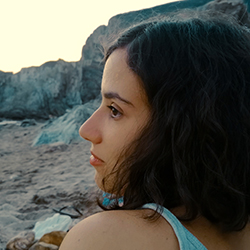
 

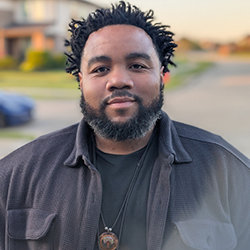
Wren Douglas is an SFF author from Italy, where they live with their devilish cats. Their work has been featured in Strange Horizons, Kaleidotrope, and the Lambda finalist anthology XENOCULTIVARS: Stories of Queer Growth, among other venues. They’re @awritingwren on Bluesky.
Climax as Supernova by Sadee Bee

Equal in enormity, still distant to human touch. Any pleasure
felt would singe those who hover above or beneath me. 
I don’t need my combustion quenched by the coolness of a wet 
mouth or sharp teeth grazing skin comprised of cosmic dust;
but by an embrace unafraid of what will seep from me. Come 
closer to the open space that rests between the Pillars of my thighs, 
where future big bangs slumber—hiding glittering wetness 
that resembles fragments of the Milky Way that forged me as cells 
greedy for Saturnalia—growing more distant in the expansion 
of my hips—the celestial sphere of my mind. I have become messy, 
molten, unable to form anything but destruction to those begging 
to be my reprieve. They cannot reach the core of my nebulous 
collapse—locked tight behind stellar remnants of those
that conflagrated when I refused to let go.


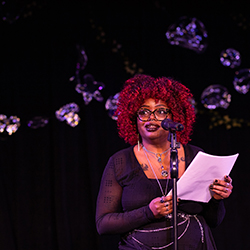
Sadee Bee (They/Them) is a queer artist and writer inspired by magic, strange dreams, and creepy vibes. Sadee is the author of Elgin Award-Nominated Magic Lives In Girls (kith books), & Celestial Bodies / Earthbound Wounds (White Stag Publishing), & The Reaper (Laughing Man House Publishing). Bee can be found on Twitter @SadeeBee, on Instagram @sadee__bee, and the web at  sadeebee.com.

Introduction by Christian M. Ivey

Dear beestung readers, 

Welcome to Issue #28, the Pleasure Issue. I do not take for granted each reader and writer that believes in the power and utility of art. Thank you to everyone who supported this idea and championed it forward. My name is the guest editor, but I am never alone on the journey. Special shout out to Sarah at beestung, K Anderson, Toyota, and the Carbon Collective. 

One of the ways I approached the theme of pleasure with this volume is with what is the difference between the pornographic and the erotic. Each of these talented writers tug at the undercurrent of their desire by naming objects that drive them forward despite the chaos of the everyday capitalistic world. It is my utmost goal to help more folks discuss what they love and hate to contend with the cultural lies regarding sexuality and gender.

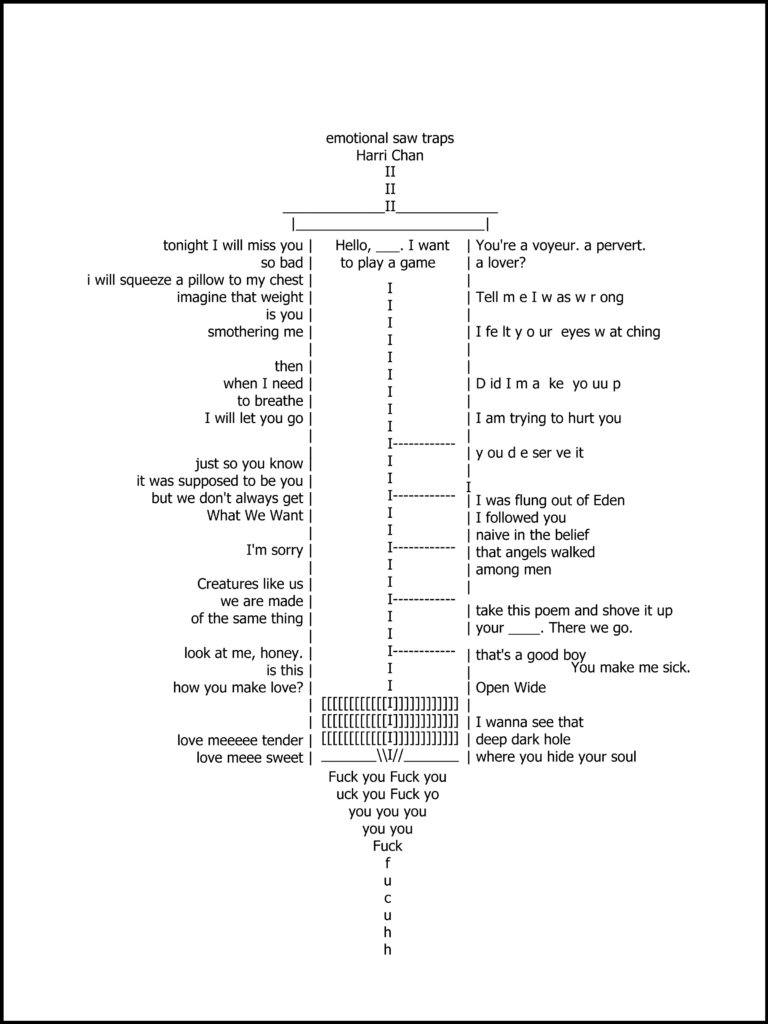
Donnie Moreland’s “BET Uncut” and “dogfart network” interrogate the risk in sexuality and how language influences the speaker’s attractions via technology such as television and music. While Harri Chan’s “emotion saw traps” is a captivating image poem that doesn’t allow want to be simple and Sheema Holmes’ “Hey, Love” is a sapphic musing on a night out which succumbs to the funny, naughty, and dorky George Violet Parker’s “Space Fuckin.’“

Emily Holland’s “Out of Focus” is our sole flash fiction that tinkers with how time can fluctuate desire. Liu’s “Nowaki” explores longing not just through words but intentionally with form while Poole’s “Midday, my lover brings home groceries” reminds us that it is the little things that matter in love. Darius Phelps’ “HONEY-COATED SKIN.” sucks us into a world where we can just about taste the lover of the speaker. Cordera’s poem, “Bruises,” tantalizes from beginning to end and then we close out with Cai Sherley’s poem, “Afro Pick Elegy” showing that us humans can care for objects just as much as people. 

I know this issue will not just turn you all on but turn you all out to something or someone new. Be sure to be on the lookout for the sister issue this fall. 

Much Love, 

Christian M. Ivey

Out of Focus by Emily Holland

Tonight, I’m skipping nostalgia. I was already in pajamas, prepared for bed, but still I was waiting, hoping for a message like this. My phone glowed in the dark. Heartbeat quickened. Madison asked to meet. We haven’t seen each other since summer ended. Busy, which is what everyone always says, though I’d gladly make the time. I don’t push. 

When we don’t see each other, we talk. Texts, mostly. Sometimes a phone call on our commutes. It was easy, those moments when we were together, bodies pressed close in the shadow of a tree or the back of a gallery’s blackbox. I’m surprised by how easy it is now, too. How open Madison feels when I can’t see her and the way I forget just how much she is still holding back. She’s told me about exes, others before me who have wanted things she wasn’t prepared to give. I can be what they weren’t, I tell myself. A role I’m prepared to play. In return, I give Madison little bits of me, things she can use to capture my tacit desires, like a net.

#

The bike ride from my apartment in the southeast quadrant of DC to the National Mall, where Madison wants to meet, is not long. Streets empty, desire pushing my pedals faster and faster. I imagine the bike alive, a body under me, pulsing. It has been a while since I have had a body under mine, being able to feel someone else’s power. I dock at the bikeshare station without fully dismounting, legs swung over to one side. One foot on a pedal, one gliding mid air. I feel like a kid again when I’m riding like this. So free. In the late night fog, my skin is damp. 

The monuments at night: cloaked in thick mist, highlighted orange from old street lamp bulbs. I like to think I can go unseen, but nothing is unseen in DC. Surveillance everywhere. CCTV cameras, cops, undercover cops, secret service cops, even the national parks have their own pseudo-cops on horses with no blinders. As young students, my friends and I would get sloshed on Watergate rum and sneak down the steps to where the Potomac licked the marble embankment behind Lincoln’s large seat. Only the bravest or drunkest would plunge into the water. It wasn’t safe, back then. A lot cleaner now. Still hazardous, sure, but not as toxic. There’s always some kind of danger in this city, even if it goes unseen.

Madison’s text said to find her at the small island in the middle of a pond named after the Constitution. Everything important around the city is named after a famous piece of paper or a famous dead white man. I cross a minimal wooden bridge, no railing, from the edge of the pond to the islet, dedicated to 56 men who signed the declaration that birthed this country. At night, in the gauzy air, it feels as if I am stepping into a mirage. In tourist season it is quiet, ignored. The pond is drastically outscaled by the neighboring Reflecting Pool. Nothing much to see other than a couple of plaques tickled by a leaning willow tree. It sits in the shadows of the monuments for wars, for presidents, for those lost along the way, each their own celebration of violence. Cattails rise out of the fog like fingers grasping for the shore. I can hear the soft paddle of ducks further out in the pond. Overhead, a bird of prey eclipses the moon.

#

She’s beat me to the island, as I expected. Her neighborhood is a bit of a walk away, but her text said she was out at a bar with some coworkers and this was on her route home. I know DC and it isn’t on the way, but the message itself was riddled with alcohol-fueled typos. What did I care if this was out of her way or not? She wrote that she wanted to see me. I didn’t realize how much I’d been waiting for this. We’d sent a few slutty texts back and forth a week ago, but didn’t get anywhere. Imagination can only take me so far.

I clear my throat and in the shadows she shifts. Madison sits on a marble ledge, looking into the fog. It’s difficult to make out the contours of her body. Head, neck, and then a blur where her body’s border blends with atmosphere. Her hair is pulled back in a tight ponytail and in the dark, it looks like water. Moonlight glints off the piercings in her ear. Six. Her torso sways a bit, maybe a deep inhale, or perhaps the fog is making my vision hazy. I sit. Heat radiates off her in the cool night. 

In just a few hours, the sun will rise over the dome of the Capitol, golden. I think Madison is going to speak first, but her mouth is on mine, dewy hands grab my face and hold me there. She tastes of tequila, lime and salt on the corners of her lips. Our mouths rough, smudging other’s edges. I feel drunk on her. We pull apart, exhales clouding, adding to the fog, our midnight cover. 

“Thank you for coming,” she says, as if I am doing her some kind of favor. Suddenly I don’t know that I want to be someone’s favor. 

“Sure,” I say. “It’s been a minute.” I don’t tell her I’ve missed her, though I have. 

“I bet you were out with other hot girls,” she says and each vowel is drawn out long, slow, from the tequila. 

“No.” I turn towards her, run my hand down the inside of her arm. Pause at her pulse. In the times we’ve been together before this, we haven’t talked exclusivity, no expectations on whatever might develop between us. “But it seems like you were?” 

“Stoooooooop it.” Drawn out again. Her hand hides her face as if she is ashamed. Is any of this between us really honest?

“It’s fine,” I say. “I hope you had a good time.” What I want to say is I had been hoping she would message, but I know that will break the spell, lift the fog. What I want to say is I was waiting for her to say she wanted to see me again. What I want to say is I hope she was thinking of me the whole time she was out.

“Hey,” she says. “No one can see us here, right?” It seems to me that we can only exist together in these semi-public spaces. She moves my hand towards the button on her jeans. Hot breath. Tequila. My forehead against hers.


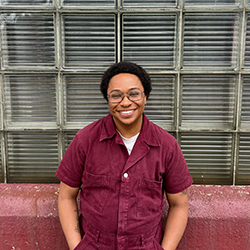
Emily Holland (they/she) is a genderqueer lesbian writer. Their debut collection, NOTIFICATIONS ON, won the Jean Feldman Poetry Prize from the Washington Writers’ Publishing House for publication in January 2027. Their work appears in publications including Zócalo Public Square, HAD, Shenandoah, DIALOGIST, Little Patuxent Review, and Black Warrior Review. They teach creative writing at the George Washington University and are the Executive Editor of Poet Lore and the Communications Manager at The Writer’s Center. Photo by Tiffany Lueong.

Bruises by Britny Cordera

The peaches on the kitchen counter 
are bruising. The bananas
hanging from the fruit rack 
next to the wrinkling mango are bruising.

On our first night together
I am bruising but nothing
is getting eaten but me.
Love bites of passion 

your body demanding
its darkness merge into my own 
marks left by your soft lips still
have yet to disappear

my body’s desire 
keeping you closer, longer.


Britny Cordera (bee) is a queer, creole, nonbinary Cave Canem poet, writer, teacher, and artist based in Oklahoma City. They received their MFA from Southern Illinois University in Carbondale. Cordera’s work can be found or is forthcoming from Purple Ink Press, Driftwood Press, Obsidian, Rhino, Narrative, Pank, Xavier Review, and other places. When they are not writing poetry or teaching, they love skating and watching anime in their free time.

BET Uncut and dogfart network by Donnie Moreland

BET Uncut

Who knew what it was,
but it was brown & slick geysers
of water, stickier than water but brown like
Momma, who Daddy said was “fine”.

or the girls who bruised their
knees at recess, beating us at foot races
                        not like them      their sisters, maybe,
                        their mothers,                           maybe.

Naked,                                                                 I think.
Strings,                                                               I think.

Who knew hair like
                                                                              like 
frost
and back dimples
that worked long after the next video ended.

Who knew what it was.

Still Tippin’       
                                 Tip Drill
                                                          Pussy Poppin’
                                                                                                My Neck, My Back

I hadn’t spelled breast yet,

or nipples, shoulders that had other purposes than sports.
Teeth without braces & smiles that had fewer gaps
than the girl whose sister
pummeled me for pulling on her pigtails
after the lunch hour.

Who knew about money showers
and silver poles, tires the size of nothing we owned.
I never asked Momma if Daddy fed her dollar bills like that.
(seemed to be the diet of “fine” women on TV)

Who knew what it was to be a man in a boy body,
under the blankets, one hand on my penis
and another on the back button of the remote control.

The most extreme sport.
(I could never remember the score of what weighed more — my penis or the trembling stick)

I risked my life for every slowed craving in my
flushed cheeks and legs,
for all the parts
Momma told me were secrets for little girls to keep,
only for their mothers and then for Jesus.

Maybe she knew where to find Christ
in the Firemen’s Azz Dance.

(she seemed to call out for the man quite often from the other side of their bedroom door)

Maybe on the floor where it seemed
all the fun was being had.

I think I grew a crush on Melyssa Ford.


dogfart network

after Black Machismo by Essex Hemphill

king kong a’int got shit
on the way i beat my meat on a talking drum
making the ground swell like a dick print in
the last high yellow bone i
bum
bum
barumbum
drum
had her stretched wide
wide like a cow fetus on the body
of an instrument to receive my war pouring
on her drum head
punchin’ through her membrane
signlin’ 1000 arrows to accompany
my precum 
who said
niggas didn’t have superpowers

CUT

am i still in character
fragile 
bent 
my dick bends in the direction 
that the director follows me 
he holds my shit when i pee
i told him again that i wasn’t 
a drum stick
so give me better lines
i almost got fired when he heard me try on 
lucille clifton’s god in wardrobe
she said, “he is heavy and hard from creation”
I assured him it wasn’t a rewrite
but was my way out of this cock cage
I’d say penis prison but that might be too on the nose
in the noose
on the nose
no, that’s right

ACTION

king kong a’int got shit
on my swollen balls
cruisin’ up ahead
like a death star
diamond in the back
sun roof
close shave for a few more inches
leave it in
while you worship me
varicose veins in a fat dick
stroke
left stroke
right stroke
kendrick lamar gave me permission
to occupy a mud hut with my eiffel tower eye sore

CUT

who were the hands
that led me out of 
master’s house
the first time
by my semen leaking
lead me
through the tool shed
on top of lover’s lake hideaway

i smell like sweet-hay
frolic
hard from creation
i cover me shy
my legs is delicate
rose pink 
blush brave
in my arch
and aching

find me
& lead me to the the generosity of fingers that 
have no owners
but give my mouth sovereignty 
i can no longer pretend

ACTION

i can no longer pretend 
take me limp
i cover me shy
soft
the director threatens to fire me
holding my dick
while i die inside the high yellow sistah
tossing up her fist and taking off the lips they gave her
talkin’ bout
fight the power
fuck her tender 
till her run off is actually wet
arousal is the first night knock to fugitivity
bum bum
barumbum
the edge 
i see the edge

past snake skin black mask
drum barrel
i was so heavy, wasn’t i

king kong did compromise for a little dick
word around town was that a Black man volunteered 
to wear that suit on set just for the free parking space
a Black man wearing a little dick
a’int it something
It’s true king kong a’int got shit on me
king kong only stopped at the tip
i took it down to the base and balls
reciting lucille clifton

while the producer cut my last check


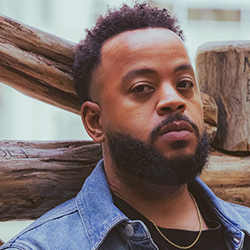
Donnie Moreland is a Houston-based poet. Donnie has contributed to Black Youth Project, ColorBloc Magazine, FIYAH Literary Magazine, A Gathering of the Tribes, Scalawag, Seventh Wave, Pangyrus, Poda-Poda Literary Journal, RawHead Literary Journal, and more. Donnie is the co-founder of Fellowship of the Griots—an ecosystem of BIPOC voices working to amplify underserved narratives, while creating opportunities for professional success through creative programming and community building. Donnie is also the author of the poetry collection, my daddy never taught me how to write a love song (Genre Urban Arts).

Nowaki by Liu Yuniang

As cicadas fall to the ground
on their backs

The remnants of summer
cling to your hair

And the sight of you
fades away

With the wane of 
the moon

I want to dip my feet
into the crash of the waves

Because despite us being 
under the same sky

It is the bygone summer sea
that dissipated the memories

Of the stars
in your auburn eyes

– the typhoon
                                                     in the 

                                                                                                                                                                                                                                                       early autumn

is 

my agony of                                                                                                                                                                                                                                       longing.


Liu Yuniang (they/them) is a Chinese-Indonesian student, poet, and writer currently based in Tokyo. They like to read queer literature, take walks in small alleys, and write about strange things in hopes that something cool happens in the small neighborhood they live in where nothing ever happens.

Afro Pick Elegy by Cai Sherley

I and my dead have lived to dirge another day, still
missing
her beloved teeth. My oiled palms quaff coral fields
without
the care of polymer & steel, the till-less aftermath a study in
grief,
the fly away nature of absence. I am a headful of detritus with
a tank
full of gas and no will, survival a Black beauty supply two miles
too far
from here & now. In absentia I walk without my beauty,
knowing
the white world cannot see, cares nothing about this kind
of loss.


Cai Sherley (he/him) is a Black trans poet-educator with roots in Boston, MA. A two-time Pushcart Prize nominee, his poems can be found in Best New Poets, swamp pink, and Peach Mag, among others. His work centers Black transmasculine life, past and present, in the United States. He has found homes at The Watering Hole, Brooklyn Poets, Tin House, and Lambda, and is a member of the Crossroads Writers Collective and Trans Corner Poets. His debut chapbook, Out of Yearning, is set to be released in October 2026 by Sibling Rivalry Press. You can find him on the internet @crsed_poet.

HONEY-COATED SKIN. by Darius Phelps

I fight the urge to rub my tongue
against the sweetness of you,
to test the rumor my mouth
keeps telling my body—
that devotion can taste like this.

I crave to love you out loud,
the way you deserve,
without whispering my want into corners,
without shrinking my hunger
to fit inside somebody else’s gospel.

I memorize every line 
of your love languages
like psalms from the Bible—
recite them when I’m alone,
murmur them when my faith gets shaky.

Your presence teaches me patience
& undoes it at the same time.
You are the ache I don’t pray away,
the blessing I let linger on my lips.

I want to learn the geography 
of you slowly—
the pauses, the soft places,
the way your breath changes 
when you feel seen.
I want to stay there.

Let my desire be careful &  bold.
Let it kneel without shrinking.
Let it speak your name
like a vow my body has already made.

I don’t want restraint if it means silence.
I don’t want holiness without heat.

If loving you is a form of worship,
then let me do it honestly—
with my mouth full of praise,
with my hands learning 
what reverence feels like,
with honey still clinging
to every part of you
that I touch…


Dr. Darius Phelps is the author of My God’s Been Silent (Writ Large Press, 2026) and The Holy Ghost Lives In Her Laugh (Kith Books, 2026). A poet before anything else, his work bears witness to grief, faith, and the act of becoming—offering language as a form of liberation and light. Through the lens of poetic inquiry, Dr. Phelps explores how verse can function as pedagogy, healing and survival. Rooted in Black literary traditions and personal testimony, his work has been featured or is forthcoming in  Frozen Sea, wildness, Diode, Tupelo Quarterly, Matter Monthly, Cultural Daily, Een Magazine, School Library Journal, and many more.  He lives in Brooklyn, NY.